Is a signed ticket stub worth more than a plain one
Usually yes, and by roughly double. But a signature is not a guarantee, and there is a right and a wrong way to get one added.
18 Aug 2026
Usually yes, and by a lot. Comparing signed against unsigned copies of the same ticket across 57 moments, the signed one sold higher 45 times, typically for about two and a half times the price. Across the whole market, 858 signed stub sales have a middle price of $690 against $420 for 5,286 unsigned ones. It is not automatic though, and the exceptions are worth understanding before you spend money chasing one.
What the numbers say
| Stub | Sales | Middle price | Highest sale |
|---|---|---|---|
| Signed | 858 | $690 | $91,500 |
| Unsigned | 5,286 | $420 | $480,000 |
That table understates the effect and overstates it at the same time, which is why the comparison at the top of this page is the one to trust. It understates it because signed and unsigned stubs are not the same tickets, and the biggest moments in the hobby mostly predate anyone thinking to get a ticket signed. It overstates it in the other direction for the same reason.
Hold the ticket constant and the picture is clean. Among the 57 moments where we have recorded both a signed and an unsigned sale, the signed copy won 45 times, and the typical winning margin was 2.42 times the unsigned price.
When a signature does not win
Look at the right-hand column of that table again. The highest signed stub sale on our records is $91,500. The highest unsigned one is $480,000. A signature adds a great deal to a given ticket, and it does not turn an ordinary ticket into a famous one.
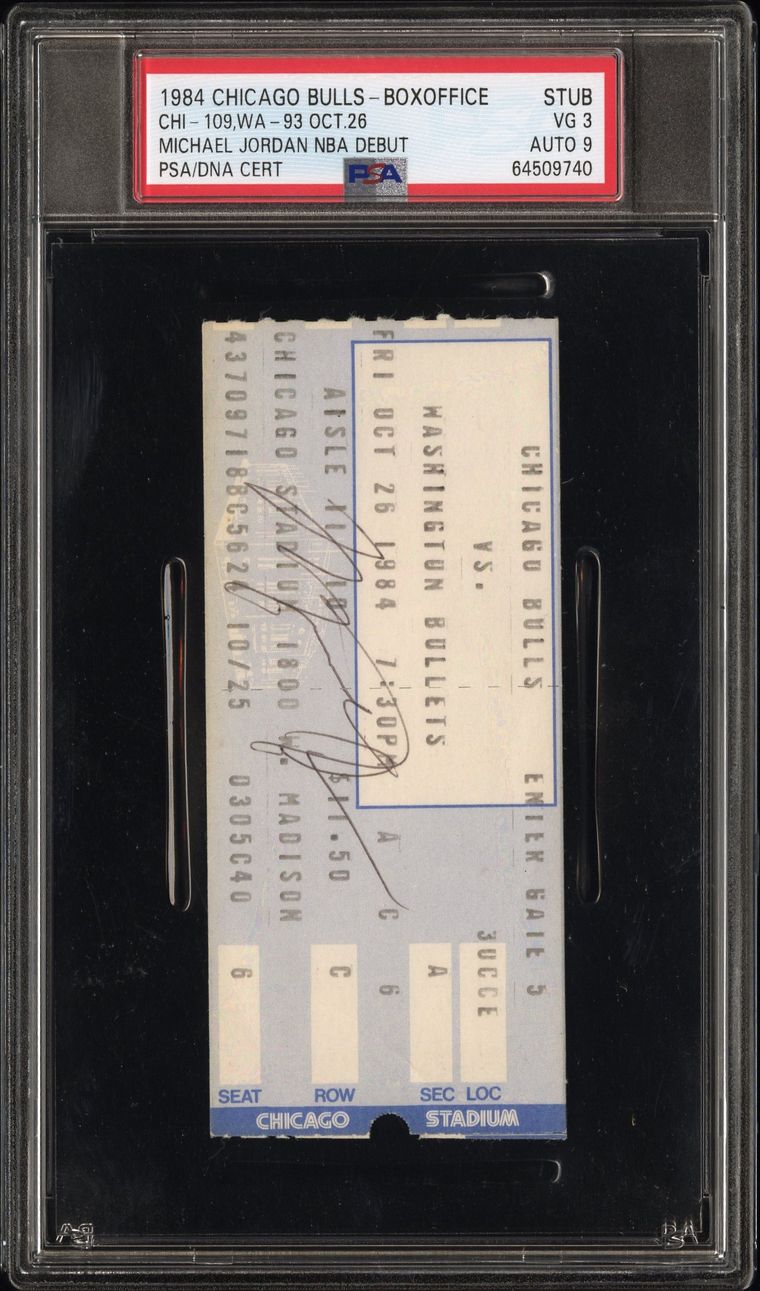
There is a sharper example in our own data. A Michael Jordan NBA debut stub signed by Jordan, with the autograph graded MINT 9 and the ticket itself graded 3, sold for $78,000 in 2022. An unsigned copy of the same ticket graded PSA 8 sold for $341,600. On a ticket that everybody wants, the condition of the card can outrun the signature on it.
So the honest rule is this. If you already have a signed stub, it is very likely worth more than the unsigned version. If you are choosing what to buy, do not assume a signature beats a grade.
Get the signature authenticated, separately
A signed ticket carries two judgements, not one. PSA grades the ticket out of 10 in the usual way, and PSA/DNA separately authenticates and grades the signature, also out of 10. Both end up printed on the label, and a buyer reads them as two different pieces of information.
This matters more than anything else in this post. An unauthenticated signature on a ticket is, to a buyer, a mark on a ticket. It can lower the value rather than raise it, because they cannot tell whether they are looking at an autograph or at somebody's biro. Every result in this article is a stub where the signature has been through authentication.
| Signed stub | Autograph grade | Ticket grade | Sold for |
|---|---|---|---|
| Michael Jordan, Bulls preseason debut 1984 | NM 7 | Authentic | $91,500 |
| Michael Jordan, NBA debut 1984 | MINT 9 | PSA 3 | $78,000 |
| Roger Maris, 61st home run 1961 | MINT 9 | Authentic | $48,000 |
| Michael Jordan, 1982 NCAA final | GEM MT 10 | PSA 5 | $43,920 |
| Tom Brady, professional debut 2000 | MINT 9 | Authentic | $39,600 |
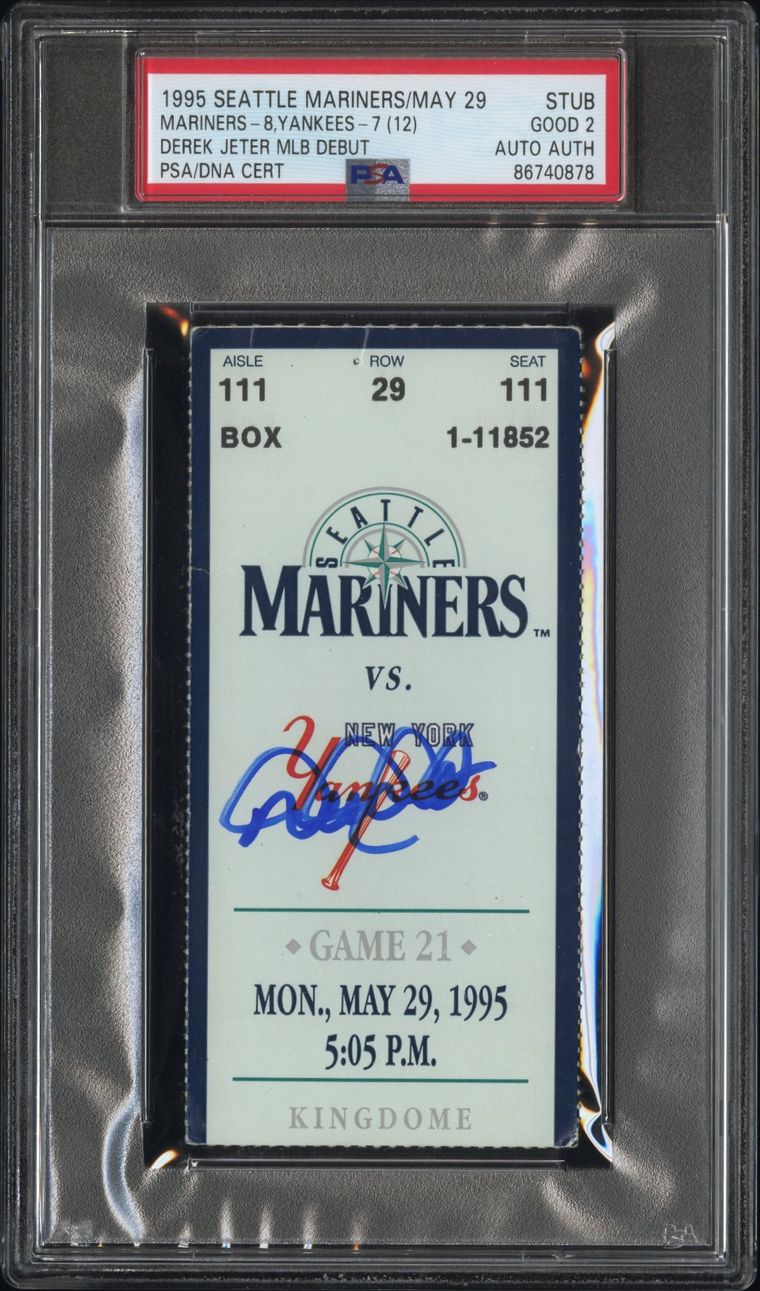
| Derek Jeter, MLB debut 1995 | Authentic | PSA 2 | $38,430 |
If you are getting one signed
Say you are going to a signing with a stub in your pocket. The signature is going to be graded, so a few small decisions made in the queue are worth real money later. What graders are assessing is essentially how complete, clean and undisturbed the signature is.
| Do | Why |
|---|---|
| Keep the whole signature on the ticket | A signature running off the edge is incomplete, and an incomplete autograph will not reach the top grades |
| Sign a flat, undamaged area | Ink laid across a crease breaks up and skips, and the grader sees a broken signature |
| Pick a light area of the design | A signature over dark print or a photograph is hard to read and harder to authenticate |
| Use a pen that sits on the surface | A fine Sharpie is the reliable choice. It does not bleed into the paper and it does not sit wet |
| Let it dry before it goes anywhere | Smudging is permanent, and it is the most common self-inflicted damage |
| Ask for one clean signature | An interrupted or retraced autograph reads as hesitant and grades lower than a single confident pass |
Two things to avoid outright. Ballpoint often will not take properly on a coated modern ticket and can be scratched off. Anything gel based or water based can run later if the ticket ever meets damp, and once it has run there is nothing to be done.
And if the ticket is genuinely valuable unsigned, think hard before adding anything to it at all. Once there is ink on it, that decision cannot be reversed.
Common questions
- Is a signed ticket stub worth more than an unsigned one?
- Usually. Comparing signed and unsigned copies of the same ticket across 57 moments, the signed one sold for more in 45 cases, typically about two and a half times as much.
- Does a signature need to be authenticated to add value?
- In practice yes. PSA/DNA authenticates and grades the signature separately from the ticket, and both appear on the label. An unauthenticated signature can reduce the value, because a buyer cannot tell it apart from a random mark.
- Can a signed stub be worth less than an unsigned one?
- Yes. The highest signed stub sale on our records is $91,500 against $480,000 unsigned, and a PSA 8 unsigned Michael Jordan debut stub sold for $341,600 against $78,000 for a signed copy graded 3.
- What pen should be used to sign a ticket stub?
- A fine Sharpie. It sits on the surface without bleeding, dries quickly and does not run if the ticket later meets damp. Avoid ballpoint on coated modern tickets and avoid gel or water based inks.
- Where should the autograph go on a ticket?
- Fully on the ticket, on a flat undamaged area, over a light part of the design. A signature that runs off the edge is incomplete and will not reach the top autograph grades.