Where to do your graded ticket research
There is no single place that tells you how many of your ticket exist, what they look like and what they sell for. Here is how to assemble the answer from the four sources that actually hold it.
7 Sept 2026
If you want to know what a graded ticket is worth, you need three things: how many exist at each grade, what the copies actually look like, and what they have sold for. No single site gives you all three, and PSA, the company that grades them, gives you only the first. In practice you assemble the answer from four places: a database that joins the counts to the photographs and the prices, the auction house archives themselves, and two groups of people who have been doing this longer than any database has existed.
Start with what PSA publishes, and know exactly where it stops
PSA is the grading company. When a ticket is sent in, they authenticate it, give it a condition grade out of 10 and seal it in a plastic holder with a printed label. They also publish a population report, which is a public tally of how many copies of each ticket they have graded, broken down by grade. It is the closest thing this hobby has to a census, and it is genuinely useful: if the report says nine copies exist at grade 8, that is the number.
Then it stops. The population report is a grid of numbers. It carries no photograph of the ticket, so you cannot check that the row you are reading is the same ticket you are holding. It carries no price, so a count of nine tells you nothing about what nine is worth. And the individual certificate pages, which do carry a photograph, are not reachable from the report. You can go from a certificate number to a picture, but you cannot go from the population report to the pictures. That one missing link is the reason most people give up on graded ticket research after twenty minutes.
The population report with the photographs attached
Collectors Tools rebuilds the population report as something you can actually walk through, and it starts from the one fact printed on every ticket: the date. Enter the date on yours and you get the events from that day, then the forms that exist for that event (a stub, a full unused ticket, a pass), then the grade ladder with PSA's counts on it, and then every graded example we hold, each with its slab photograph and, where we have one, the price it sold for.
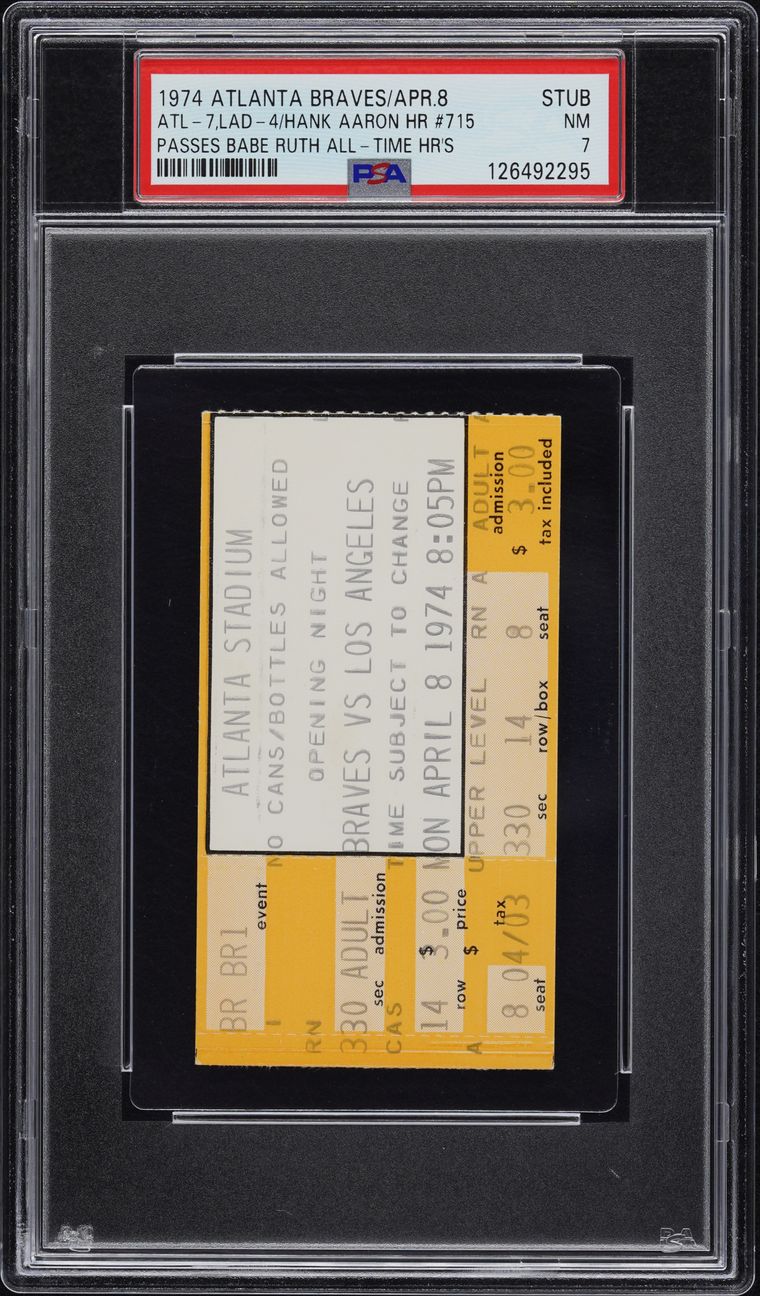
Take that Aaron game as a worked example. PSA's July 2026 census counted 495 graded copies of it across all its forms. Collectors Tools holds photographs of 370 of them and 36 recorded sales, running from $233.50 for a low grade stub to $10,065 for a full ticket in August 2026. That is the whole picture in one place: how many, what they look like, what they fetch. You can read that moment on the population database, or read the prices for the stub here.
The honest limits, because they matter. The census is a reading taken on a date, not a live figure, and about half the catalogue has never been censused at all, so a page that says "not yet censused" means exactly that and not "none exist". And every count on it is a PSA count. Tickets graded by other companies are not in it.
One ticket at a time, by the number on the label
If you already have a certificate number, the long number printed at the bottom right of the label, the cert scan search is the direct route. It holds 109,573 graded tickets, 79,095 of them with the slab photograph, and you can search it by the certificate number, by player, or by the event. It is also the fastest way to check a ticket you are about to buy: put the seller's certificate number in and see whether the label they photographed matches the ticket they are describing.
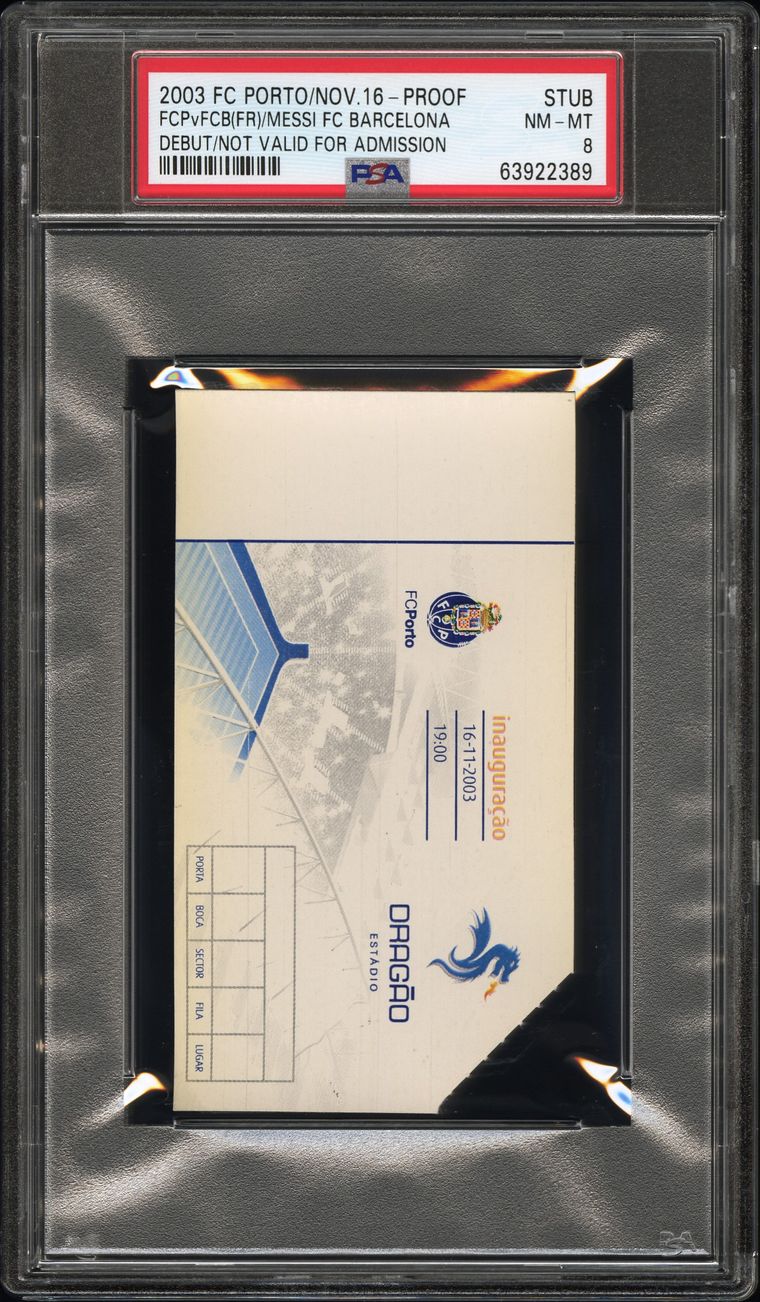
The reason those photographs matter more than they sound: two tickets from the same game can be completely different objects. A stub torn at the gate, a full unused ticket, a proof that was never valid for admission. They carry different prices and they look different, and a number in a grid will not tell them apart.
What has actually sold, in one list
Graded ticket sales happen across several auction houses and on eBay, and none of them shows you the others. The auctions page collates them: 27,171 graded ticket sales on record, the oldest from 2004, with a Sold tab for the archive and a Live tab for what is on the block right now, usually a few hundred lots.
| Where the sale happened | Sales on record | Oldest |
|---|---|---|
| eBay | 8,457 | 2011 |
| Goldin | 7,743 | 2013 |
| Heritage Auctions | 6,792 | 2004 |
| Fanatics Collect | 3,404 | 2013 |
| Lelands | 689 | 2004 |
| Six smaller houses | 86 | 2019 |
Graded ticket sales on record, by venue
Then go straight to the auction houses
An aggregate tells you a ticket like yours sold for $4,000. The auction house's own lot page tells you why. It carries the full catalogue description, the condition notes, several photographs, the provenance if there is any, and often a frank sentence about a flaw that the price is reflecting. If you are trying to work out whether your copy is better or worse than the one that sold, that page is where the answer is, and every one of these archives is free to read without an account.
| House | Worth reading for |
|---|---|
| Heritage Auctions | The deepest archive by a distance, back to 2004, with prices realised kept public permanently. Start here for anything historic |
| Goldin | The strongest run of modern six-figure ticket results, and the best photography. Their past auction results are searchable by keyword |
| Fanatics Collect | Weekly sales full of inexpensive material, so it is the best read on what an ordinary ticket really fetches rather than a headline lot |
| Lelands | Fewer ticket lots but consistently high end, and long catalogue descriptions that are worth reading for the history alone |
One habit worth building. Search each archive by the date and the teams, not by the player's name. A catalogue writer describing your game may never mention the player you care about, and searching for a name will hide the lot from you completely.
The people know things the databases do not
Ticket collecting is small enough that a few dozen people have handled most of what is worth handling, and they are easy to find. This is not a soft substitute for the data. On an unlisted or unusual ticket, a person will often answer in an hour a question no database can answer at all, because the answer is that they remember the last one selling privately in 2019.
| Where | What it is good for |
|---|---|
| Boogers, on Facebook | The main ticket stub group. Post a clear photograph of the front and back and ask what you have. Buying and selling happens here too, directly between members |
| Ticket Stand, on Discord | Faster, more conversational, better for a live question while you are deciding whether to bid on something. Grading questions get sensible answers here |
| Collectors on Collectors Tools | Browse who collects what and look through their public collections. Useful when you want to see several copies of the same ticket side by side, or find the person who specialises in your team |
How to ask, because it changes the answer you get. Photograph the front and the back, flat, in daylight, with the whole ticket in frame. Say the date and the teams. Say whether you are selling, and say if you are not. Do not ask "what is this worth" as your opening line. Ask what it is, and the value question answers itself in the replies.
A routine that works
| Step | Where |
|---|---|
| Work out which game it is, from the date on the front | The calendar, or the date search on the population database |
| Find out how many exist, and see what the graded copies look like | The population database |
| Check what copies have actually sold for | The sold archive |
| Read the lot page for the closest comparable sale | The auction house's own archive |
| Ask about anything the first four could not settle | Boogers, or Ticket Stand |
If your ticket has never been graded, most of this still applies, with one caution. Every price in every source above is the price of a graded ticket, so none of it is a valuation of a loose stub in a drawer. For that, start with what a ticket stub is worth and be careful not to read a slab price as your price.
Common questions
- Where can I look up a PSA graded ticket?
- By certificate number on PSA's own site, which gives you a photograph of that one slab, or on the Collectors Tools cert search, which holds 109,573 graded tickets with 79,095 slab photographs and lets you search by player and event as well as by number.
- Does PSA show you what a graded ticket sold for?
- Not for tickets. PSA publishes Auction Prices Realized, but it is essentially empty for the ticket category, so sold prices have to be collected from the auction houses and eBay separately. Collectors Tools holds 27,171 such sales going back to 2004.
- Can you see photographs of every graded copy of a ticket?
- Not from PSA's population report, which is counts only and does not link to the certificate pages. The Collectors Tools population pages join the two, so each grade on the ladder opens the actual graded examples with their slab photographs.
- How many graded tickets exist in total?
- PSA had graded 282,765 tickets at the census reading on 8 July 2026, across 71,457 distinct items. That figure grows every month, so treat it as a reading with a date on it rather than a constant.
- Are the auction house archives free to search?
- Yes. Heritage, Goldin, Fanatics Collect and Lelands all keep their past results public and searchable without an account. Search by the date and the teams rather than by a player's name, because the catalogue description may not mention the player at all.