Does a crease or a tear ruin a ticket stub's value
A stub is a torn ticket by definition, so the tear is the normal state. A fold is a different problem, and it is the one that costs you a grade.
18 Aug 2026
A tear usually does not ruin it. A hard fold usually does hold it back. Your stub is a torn ticket by definition, so graders assess what is left rather than punishing you for the tear, and stubs graded as low as 1.5 have still sold for six figures. A deep crease across the face is different, and in practice it caps most stubs somewhere around a 3 or 4 out of 10.
Why the tear is not the problem
When you handed your ticket over at the turnstile, somebody tore it and gave you back the stub. Every stub in existence went through that, so a torn edge is not damage in the way a stain or a fold is. It is the defining feature of the object.
Graders do look at the tear. A clean tear along the perforation reads better than a ragged one that has taken a chunk out of the printed area, and a tear that removes part of the date or the teams costs you more than one through blank card. But it carries far less weight than the four things that decide most of the grade: the corners, the edges, the surface and how well centred the print is. Those are assessed on every graded item PSA handles, and a stub is no exception.
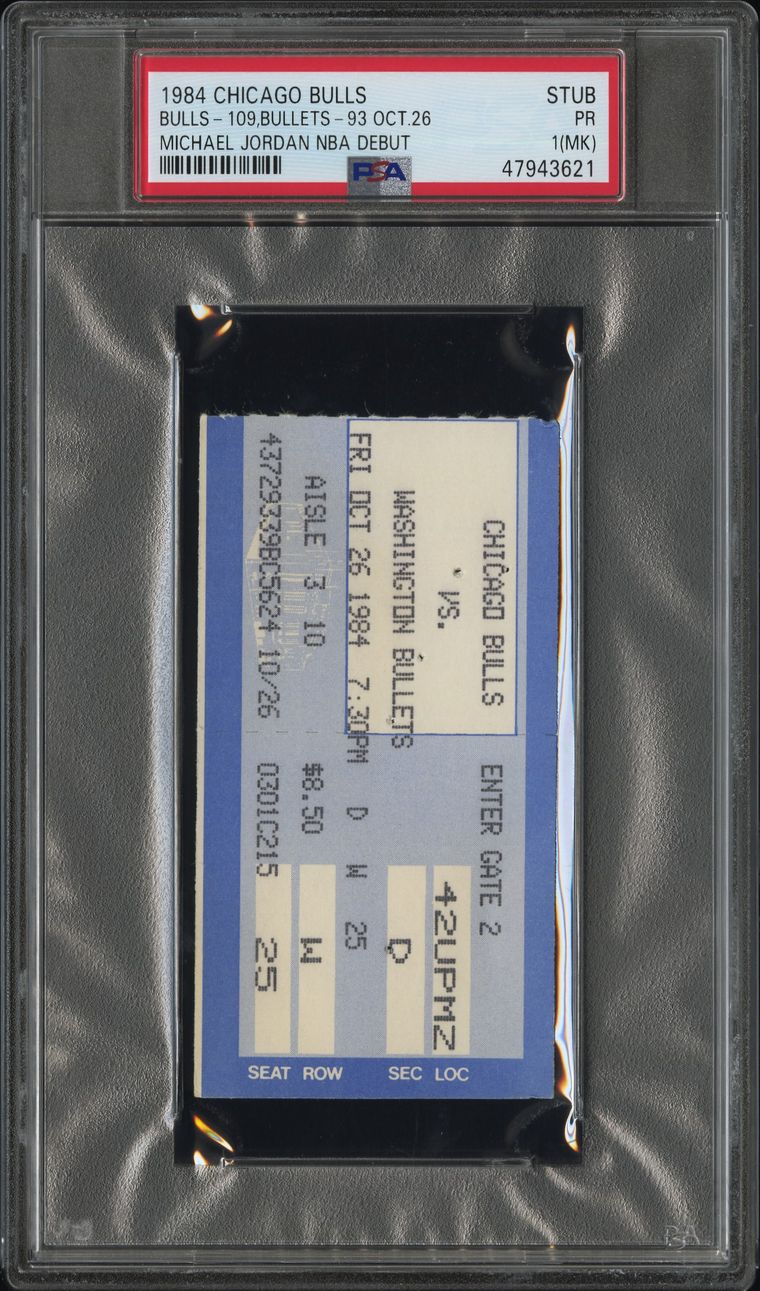
The fold is the problem
A fold is a break in the paper fibres running right across the face of the ticket. Unlike a soft bend it does not relax, it does not press out, and it shows under the light no matter how the holder is angled. It is surface damage, which is one of the categories that carries real weight.
In practice a stub folded once and firmly is looking at a 3 or a 4 rather than a 6 or a 7, and each additional fold pushes it further down. The classic case is the stub that lived in a wallet or was folded into a programme, which arrives with two crossing folds and grades accordingly. Nothing you can do at home improves this. Flattening it under books does not repair fibres, and pressing or trimming a ticket is the kind of alteration that gets it labelled rather than graded.
So what is a grade actually worth
Here is where almost every article on this subject goes wrong, so it is worth being careful. If you line up all 6,143 stub sales where we know PSA's own grade and chart price against grade, the line is flat. Stubs graded 10 have a lower middle price than stubs graded 2. That is a real result in our data and it is completely misleading.
The reason is that grade and importance are tangled together. The tickets people cared enough to keep from 1947 are battered, and they are also the ones worth a fortune. The tickets that survive in perfect condition are mostly modern and mostly ordinary. Comparing a PSA 10 from 2015 to a PSA 2 from 1947 tells you nothing about condition.
The honest way to measure it is to compare copies of the same ticket at different grades. Do that and condition shows up clearly:
| Comparison, same ticket | How often the higher grade sold for more | Typical premium |
|---|---|---|
| Any grade step up (668 comparisons, 228 moments) | 63% | 29% more |
| A big jump, grade 7 or better against grade 4 or worse (43 moments) | 67% | 54% more |
Two things follow. Grade genuinely moves the price, so condition is worth protecting. And it moves it by tens of percent rather than by multiples, so it is not the thing that decides whether your stub is worth $300 or $300,000. The day it was printed decides that.
Where a grade really does run away
The averages hide what happens on a ticket enough people want. Michael Jordan's first NBA game is the clearest example we hold, with 28 recorded sales spread right across the grade scale:
| Grade | Sales | Middle price |
|---|---|---|
| Authentic, no numeric grade | 6 | $11,550 |
| PSA 2 | 6 | $19,650 |
| PSA 3 | 7 | $18,600 |
| PSA 4 | 3 | $73,200 |
| PSA 5 | 2 | $52,875 |
| PSA 6 | 4 | $72,764 |
| PSA 8 | 2 | $311,100 |
That is not a tidy line, and the sample gets thin at the top, but the shape is unmistakable. On a ticket this sought after, the gap between an Authentic copy and a PSA 8 is roughly twenty-seven times. When lots of people want the same ticket, they compete on the only thing left to compete on.
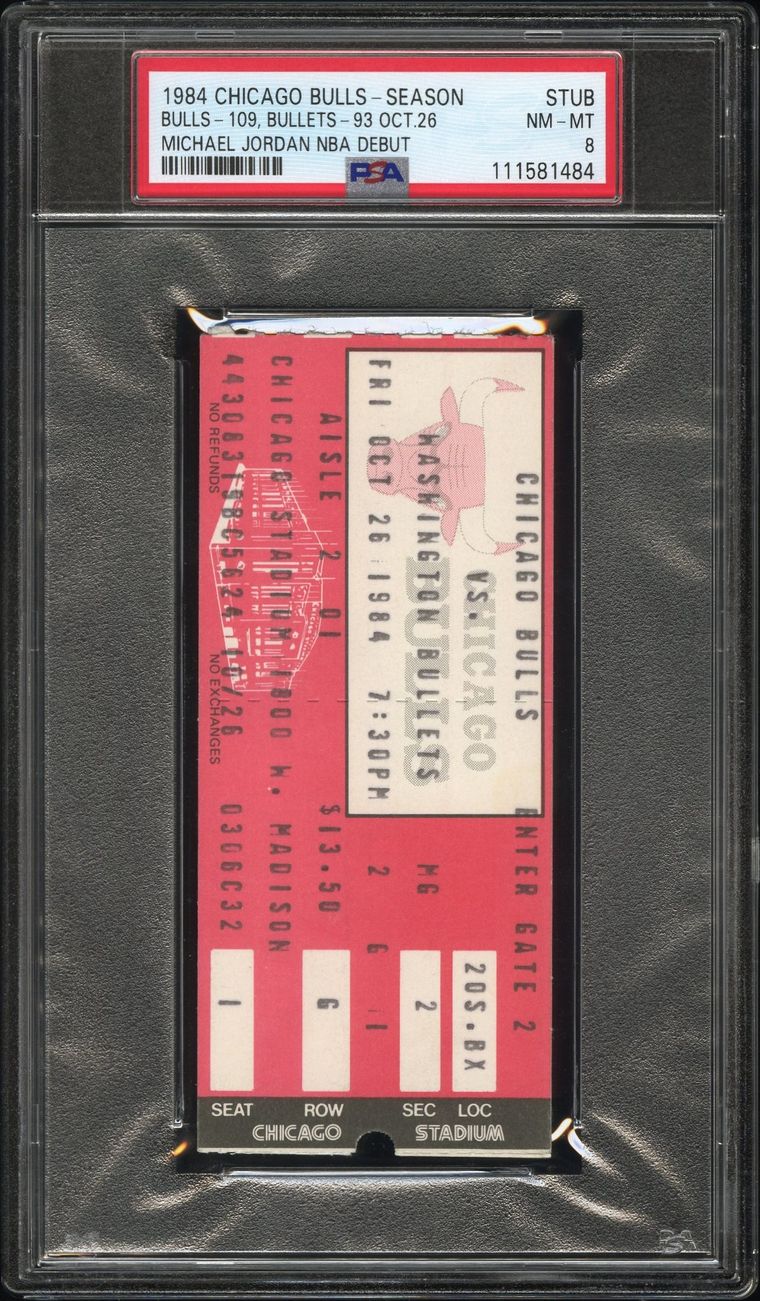
If your stub is modern, condition is the whole game
This is the part worth acting on. Tickets from 2000 onwards survive in far better shape than older ones, because they were kept deliberately by people who already thought of them as collectable. Our population census, read on 8 July 2026, shows how lopsided this is:
| When the ticket is from | Graded copies | Share graded 9 or 10 | Share graded 10 |
|---|---|---|---|
| 2000 and later | 88,999 | 32.5% | 16.5% |
| Before 2000 | 145,014 | 7.8% | 2.6% |
One in six modern graded tickets is a perfect 10. Against that, a modern stub graded 7 is unremarkable, because a buyer can simply wait for a 10 to come along. On a pre-2000 ticket, where only one in forty makes a 10, a mid grade is often the best copy anyone is going to see. The newer your stub, the more the grade has to carry.
Common questions
- Does a tear reduce the value of a ticket stub?
- Usually not much. A stub is a torn ticket by definition, so graders weigh the corners, edges, surface and centring far more heavily. Stubs graded as low as 1.5 have sold for over $300,000.
- Does a crease ruin a ticket stub?
- It does not ruin it, but it holds the grade down. A single firm fold typically limits a stub to around PSA 3 or 4, and further folds push it lower. Creases cannot be repaired at home.
- How much more is a high grade ticket stub worth?
- Comparing copies of the same ticket, the higher graded one sold for more in 63% of 668 comparisons, typically about 29% more. On a big jump from grade 4 or below to grade 7 or above, the typical premium is 54%.
- Should I flatten a folded ticket stub before grading it?
- No. Pressing does not repair broken paper fibres, and altering a ticket risks it being labelled as altered rather than given a grade. Send it as it is.
- Is condition more important on a modern ticket stub?
- Yes. Among graded tickets from 2000 onwards, 32.5% grade 9 or 10 and 16.5% grade a perfect 10, so a mid grade modern stub has a lot of better copies to compete with. Before 2000, only 2.6% reach a 10.